PPF vs. Ceramic Coating: A Houston Detailer's Honest Answer
Watch the reel that started this blog post here:
https://www.instagram.com/p/DZqamrwB6oI/
A customer asked me this exact question while I was working on his vehicle last week in Katy. He'd done his research, seen both terms everywhere — PPF and ceramic coating — and still wasn't sure which one was actually worth his money.
My answer: comparing PPF to ceramic coating is like comparing apples to oranges — if one of them was significantly more expensive than the other. Both are forms of paint protection, but they protect against completely different things, they sit in completely different price brackets, and one is not a substitute for the other.
And in Houston specifically, this question matters more than it does in most cities. Between the brutal UV exposure from March through October, I-10 and 99 kicking up constant road debris, iron fallout from industrial areas, bug splatter season, and humidity that parks on your clear coat — your paint takes a beating here that drivers in cooler, drier climates don't deal with the same way.
Here's the complete breakdown — what each one does, what it doesn't, real pricing in the Houston area, and how to decide which one makes sense for your specific vehicle and driving situation.
What Is PPF (Paint Protection Film)?
Paint Protection Film — also called PPF, clear bra, or paint protection film — is a thick, transparent thermoplastic urethane film that is physically applied directly to your vehicle's painted surfaces. It's typically installed on the highest-impact areas: front bumper, hood, fenders, side mirrors, door edges, and headlights.
The key word is physical. PPF creates a sacrificial barrier between your paint and the road. When a rock kicks off the freeway and hits your hood at 70 mph on I-10, the film absorbs and disperses that impact instead of your clear coat. Premium PPF products — brands like XPEL, STEK, and 3M — are self-healing: minor scratches in the film disappear on their own with heat from the sun or warm water.
What PPF protects against:
Rock chips and road debris — this is its primary job, and nothing else does it as well
Minor scratches, scuffs, and abrasions from daily driving
Bug splatter and bird droppings (when cleaned promptly)
Light swirl marks from automatic car washes
Some UV protection on the covered panels (varies by brand)
What PPF does NOT protect against:
UV fading and paint oxidation across the full vehicle — PPF covers high-impact zones, not every panel
Water spots, mineral deposits, and iron fallout that accumulate over time
Chemical stains from industrial fallout (common near the Energy Corridor and Port of Houston areas)
The cost — full-vehicle PPF in the Houston area typically runs $2,000–$5,000+ depending on vehicle size, film brand, and coverage level
Houston-specific note on PPF
If you drive I-10, Highway 6, or the Grand Parkway regularly — especially through construction zones around Katy and Cinco Ranch —
rock chip risk is genuinely elevated compared to most urban driving. PPF on the front end of a vehicle that sees those roads daily
is not a luxury purchase; it's practical protection.
What Is Ceramic Coating?
Ceramic coating is a liquid nano-polymer — typically SiO2 (silicon dioxide) or a hybrid SiO2/graphene formula — that chemically bonds to your vehicle's clear coat and cures into a hard, glass-like protective layer. Once applied correctly, it becomes semi-permanent: it doesn't wash off the way wax does.
Think of it as a permanent, dramatically stronger replacement for wax. Where a traditional wax job lasts 1–3 months before it degrades and washes away, a quality ceramic coating in Houston lasts 1–5 years depending on the product tier, prep work, and how well it's maintained. Some commercial-grade coatings rate for longer.
What ceramic coating protects against:
UV rays and sun-induced paint fading — critical in Houston where summer UV index regularly hits 10–11
Paint oxidation from prolonged heat and humidity exposure
Iron fallout and industrial contamination — bonds to the coating instead of your clear coat
Bug splatter, bird droppings, and tree sap — releases far more easily from a coated surface
Water spots and mineral deposits — water beads off instead of pooling and evaporating on the surface
Chemical stains from road grime, fuel, and environmental contaminants
The need for waxing — for the life of the coating, you're done with wax entirely
What ceramic coating does NOT protect against:
Rock chips — the nano-coating layer is 1–5 microns thick; it adds hardness but cannot absorb physical impacts
Deep scratches — a key scratch, door ding, or collision will still damage the paint underneath
Improper installation — ceramic coating applied over contaminated or swirled paint seals those defects in permanently; paint correction must come first
Houston-specific note on ceramic coating
Houston's combination of intense UV (100°F+ summers), high humidity, acid rain near industrial zones, and heavy pollen from
February through May makes ceramic coating particularly valuable here compared to cooler climates. UV-induced paint fading and
oxidation happen faster in South Texas than almost anywhere in the country. A ceramic coating with strong UV inhibitors
is one of the most practical long-term paint investments a Houston driver can make.
What Happens to Paint in Houston Heat — and Why Protection Matters More Here
Most generic PPF vs ceramic coating articles are written for a national audience. Houston has a specific set of paint threats worth naming explicitly, because they should influence which product you prioritise:
UV exposure:
Summer heat cycling:
Road debris on major corridors:
Industrial fallout:
Bug and pollen season:
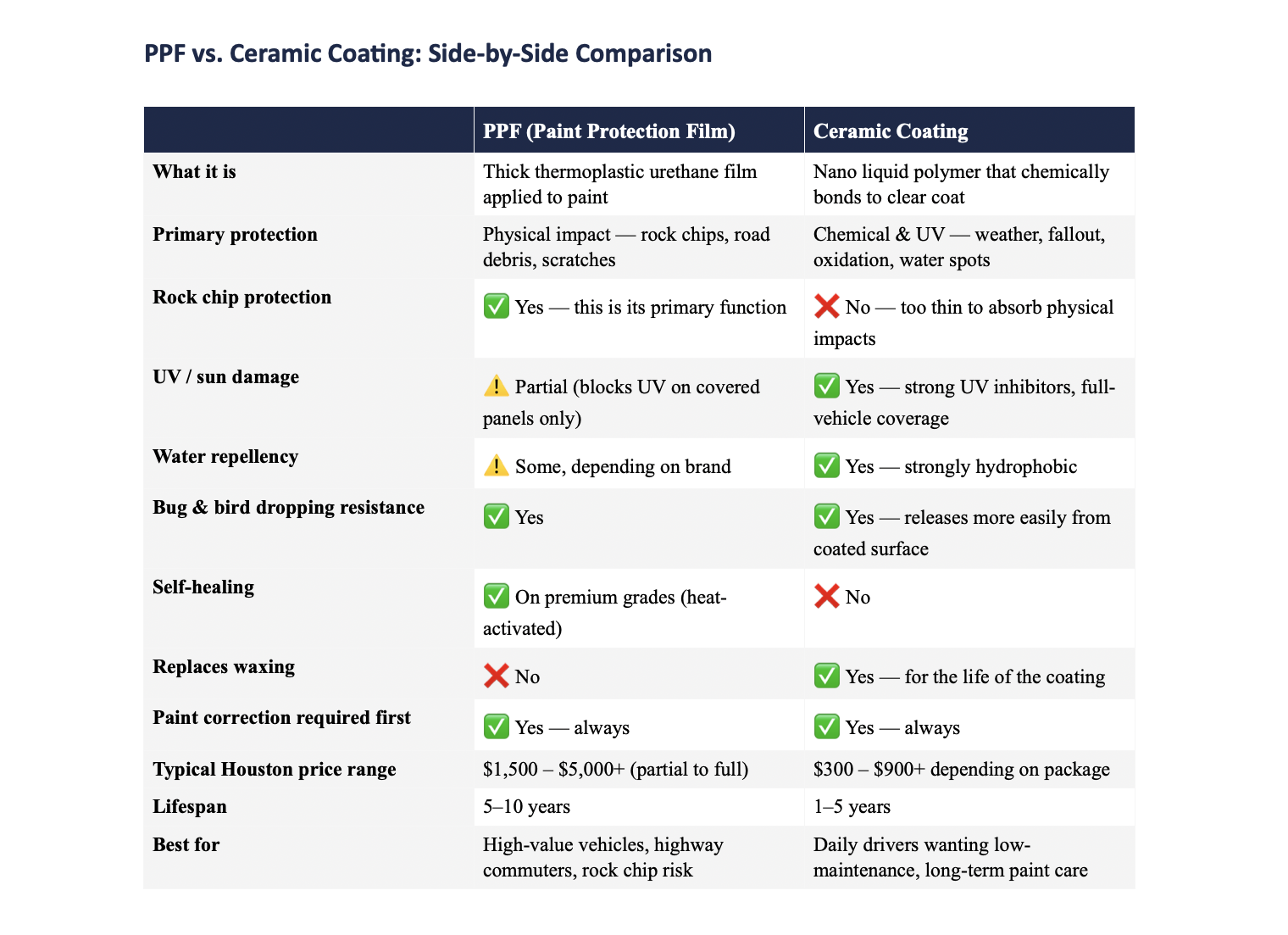
PPF v.s. Ceramic Coating Comparison Table
So Which One Should You Get?
Here's how I actually help Katy and Houston customers work through this decision:
Choose PPF if…
You drive significant highway miles, especially on I-10, Highway 99, or 290 where rock chip risk is high
You own a high-value vehicle — exotic, luxury, or a car whose resale value you want to protect
You've dealt with rock chips before and are tired of touching them up
Budget is secondary to maximum physical protection
You're buying a new vehicle and want to protect the factory paint from day one
Choose ceramic coating if…
You want long-term paint protection without the PPF price point
UV damage, water spots, bug splatter, and ease of maintenance are your main concerns
You're tired of waxing every few months and want to eliminate that step entirely
You drive a daily vehicle that sees normal road and parking conditions
You want whole-vehicle coverage — ceramic coating every panel, glass, wheels, and trim for a fraction of full-vehicle PPF cost
The Combo Option: PPF + Ceramic Coating Together
More and more Houston drivers are doing both — and it's actually the setup that makes the most sense for vehicles that see serious use. Here's how it works:
PPF on the high-impact zones — front bumper, hood, fenders, mirrors, and door edges. These are the panels that take the most physical abuse from road debris.
Ceramic coating over the rest of the vehicle — all remaining panels, plus glass, wheels, and trim. This gives you full-vehicle UV protection, hydrophobicity, and the easy-maintenance benefits of a coated surface everywhere PPF doesn't cover.
Some installers also apply ceramic coating over the PPF itself — which adds gloss and hydrophobicity to the film, since PPF alone doesn't add the same visual depth that ceramic does. This is the most comprehensive setup available and is worth asking about if you want complete coverage.
Common Questions We Get in Katy and Houston
Is ceramic coating worth it in Houston heat?
Yes — arguably more so than in most other cities. Houston's UV index and summer temperatures are hard on unprotected paint. The UV inhibitors in a quality ceramic coating slow down fading and oxidation significantly, and the hydrophobic surface makes removing bug splatter, pollen, and road grime (all abundant in this climate) dramatically faster. For most daily drivers in the greater Houston area, ceramic coating is one of the best long-term maintenance decisions you can make.
How much does ceramic coating cost in the Houston area?
At Reflect Automotive Detailing, our mobile ceramic coating packages in Katy, Cinco Ranch, Richmond, and Sugar Land start at $500 and go up depending on vehicle size and the package tier (1-year, 3-year, or 5-year protection). Every package includes a full paint decontamination and correction first — we never apply ceramic coating over dirty or swirled paint.
How much does PPF cost in Houston?
A partial front-end PPF install (front bumper, partial hood, mirrors) in the Houston area typically runs $1,000–$2,000. Full hood coverage adds more. Full-vehicle PPF runs $3,000–$5,000+ depending on vehicle size and film brand. 70–80% of the cost is labour, because PPF is genuinely difficult to install without visible seams, bubbles, or edge lifting.
Do I need paint correction before ceramic coating?
Yes — always. Ceramic coating seals whatever is on your paint's surface. If you apply it over swirl marks, contamination, or minor scratches, those are locked in under the coating permanently. A proper paint correction and decontamination step before application is what separates a quality installation from one that will look worse over time than bare paint.
Can ceramic coating be applied over PPF?
Yes, and it's a smart combination. Applying ceramic coating over PPF adds hydrophobicity and gloss to the film itself (PPF doesn't naturally provide the same optical depth ceramic does), while giving you UV and chemical protection on the rest of the vehicle's panels. Many high-end protection setups in Houston use this combination.
How do I find a reliable ceramic coating or PPF installer near me in Katy or Houston?
Look for installers who perform paint correction before coating (not optional), ask what specific product brands they use, and ask to see examples of their actual work — not stock photos. Reflect Automotive Detailing is mobile and serves Katy, Cinco Ranch, Richmond, Sugar Land, Cypress, and the greater Houston area.
Book Mobile Detailing or Ceramic Coating in Katy and Houston
We're a fully mobile detailing operation serving Katy, Cinco Ranch, Richmond, Sugar Land, Cypress, and the greater Houston area. No shop visit needed — we come to your home, apartment, or workplace with everything we need.
📲 Call or text: 281-690-8751
🌐 Book online: www.radhtx.net/booking
📍 Serving Katy · Cinco Ranch · Richmond · Sugar Land · Cypress · Houston
About the Author
This post was written by the team at Reflect Automotive Detailing, a mobile detailing and ceramic coating service based in Katy, TX. We work on daily drivers, exotics, and everything in between — and we've been answering the PPF vs. ceramic coating question in driveways across the greater Houston area long enough to know there's no one-size-fits-all answer. If you have a question that wasn't covered here, call or text us — we're happy to talk through your specific vehicle and situation before you book anything.